
A little over a week ago, when Mark Zuckerberg started making his most obvious overtures to garner Donald Trump’s favor and people started moving to Bluesky in earnest, I saw a post from a Facebook friend that made me pause.
It was a screenshot of a social media post from a user going by feminstajones.
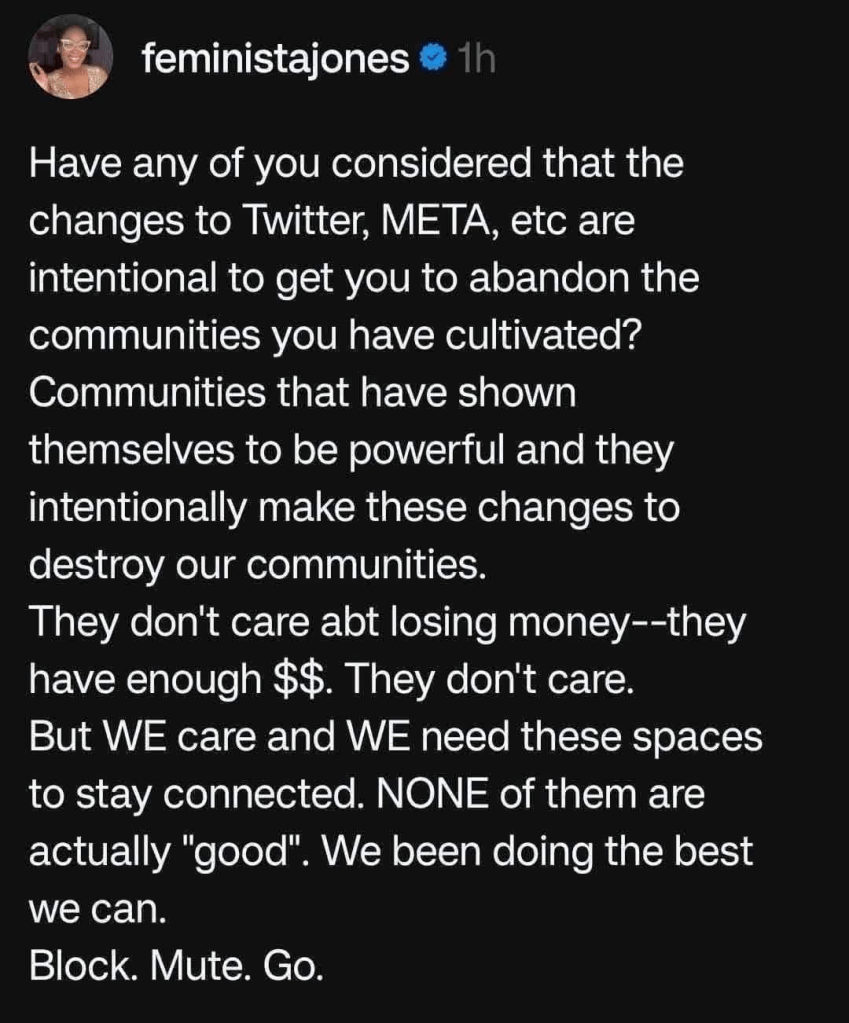
I didn’t agree with the entirety of it: The rich and powerful, as far as they are concerned, never have enough money. But she made one valid point that resonated with me: “Communities that have shown themselves to be powerful …. WE need these spaces to stay connected. NONE of them are actually ‘good.’ We been doing the best we can. Block. Mute. Go.”
The Facebook friend who shared it — a gender studies professor whose class I took in college — had her own addition: “And I won’t soon forget how Egyptians organized an entire revolution through networking on Facebook in 2011.”
Social media is a powerful tool that can be used for good — by those who choose to use it for good. My social media has actually made me a more compassionate person, because it exposes me to the perspectives and challenges faced by the most marginalized in our communities.
To be honest, I’m a social media grandma: I have Facebook, and I just got an Instagram last spring. I don’t have an interest in getting any other social media accounts. (In part because I’m hyper-cognizant of my digital footprint. And in part because social media and online games are basically dopamine slot machines — a term I am shamelessly stealing from others on the internet — and I already lose too much of my time to them.) All my communities are on Facebook: my friends, my writing groups, my book recommendation groups, my local literary and arts organizations. If they all abandon Facebook, I’ll be left behind.
I won’t say that you shouldn’t stop using Facebook or Instagram or Twitter. (If Elon Musk can deadname his kid, I can deadname his platform.) Ultimately, you’ll do what your conscience demands.
But it is worth remembering that we have established powerful and powerfully connected communities on these platforms. They have become the places where we share, organize, and mobilize. If we abandon the platform, we abandon the communities, and we have to start over again. That takes time, and when you are trying to resist an oppressive regime using “shock and awe” tactics, time is precious.
While I was doing my morning scroll today, I came across a post by author Rebecca Hains that dovetails perfectly with this. Many of the people choosing to leave Facebook and Twitter are doing so because they don’t want to keep lining Zuckerberg’s and Musk’s pockets. And that’s a perfectly valid reason. So Ms. Hains offered a good (though admittedly imperfect) solution to make it harder for the tech bros to monetize our time and attention.
You can read her original post, in which she credits a friend of a friend, Jeanne, for much of the info, here: https://www.facebook.com/share/p/12JnzWiE5HW/
But here are the steps she outlines:
So, what can you do as an alternative to leaving Meta’s platforms? Well, there are a few actions you can take that may lessen the profit they make from your engagement, and improve your user experience:
1. Opt out of Meta’s “off-Facebook activity tracking.” This is a setting deep in your account that allows them to track what you do *off* of FB so they can make more money by convincing advertisers that they’re targeted marketing to you. (I looked at mine last week and saw that they had extensive records of my Internet browsing history—really gross.)
To change this, go to Settings / Off FB Activity / Accounts Center / clear previous activity. Then also go to manage future activity – disconnect future activity.
2. “X” out any ads, sponsored content, or random product-oriented reels that FB shows you. Mark it as irrelevant; ask to never see that advertiser again. The less our on-Facebook ad exposure is tracked, the less justification advertisers have to give FB money to reach people.
3. Do not click through any ads or sponsored content to take quizzes, buy products, etc. This activity allows FB to claim that advertising on the platform is effective and generates more income for them.
4. View your feed through the “friends” filter as often as possible. To do so, go to menu / feeds / friends. There, you will only see posts from your connections — not all the ads and suggested groups and so on that Meta has been cluttering our FB feeds with in a desperate attempt to keep us engaged on the platform. If you do this enough, it should appear as a tab at the bottom of the app.
5. Do #2 and 3 on Instagram, too.
“Voting” with your money — carefully choosing which stores, vendors, or, in this case, platforms get your time and dollars — is a legitimate form of protest and one that I frequently encourage. However, we need our online communities now more than ever, and we shouldn’t let our anger at the tech bros sever us from our support systems.
If we want to resist the Trump administration, our work starts at the ground level — in our towns, our counties, and our states. But we can lean on and learn from like-minded individuals around the country and even the world — the ones with whom social media allows us to connect.
This administration is going to bombard us with hate and bigotry. They will make us feel hopeless and alone.
But we aren’t alone. We have connected and will continue to connect with others who believe in respect, equality, autonomy, and dignity.
When MAGA mobilizes the levers of power to persecute and dominate, we will leverage our online and real life communities to resist. We will oppose hatred with kindness, oppression with protection, and suppression with elevation. We will stand firm. We will not obey in advance. And we will support each other, in person and online, through this long fight.
 J. Nelson - Writer